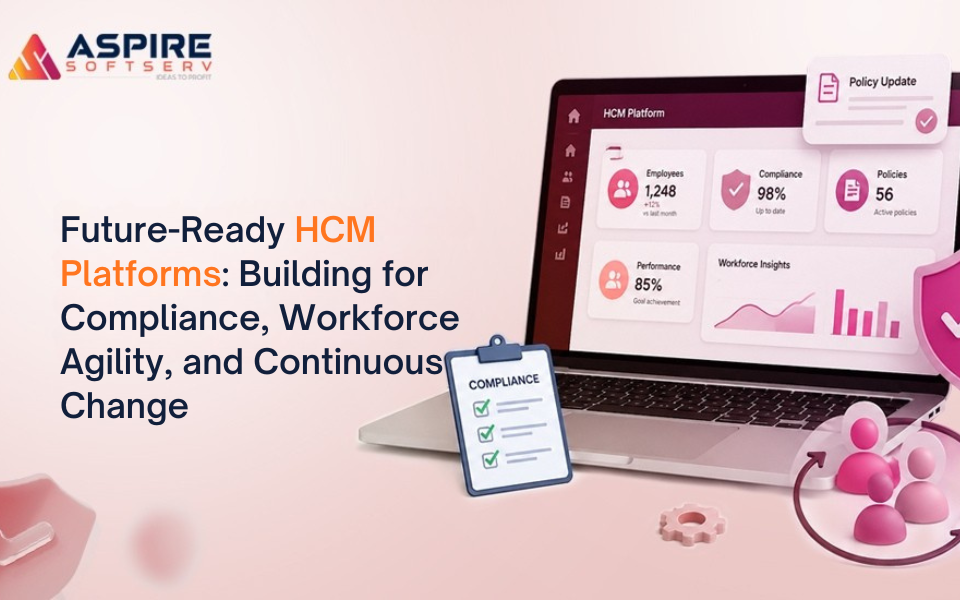
Future-Ready HCM Platforms: Building for Compliance, Workforce Agility, and Continuous Change
TL;DR
Modern businesses can no longer rely on outdated HR systems that struggle to adapt to changing workforce demands and compliance regulations. Today’s Human Capital Management (HCM) platforms must be designed for continuous evolution, automation, and scalability.
Here’s what organizations need to know:
- Legacy HR systems often fail within 12–24 months because they were not built for ongoing compliance and workforce changes.
- HR compliance issues now directly impact business risk, operational cost, and brand reputation.
- AI-powered HR automation works only when integrated into the platform architecture from the beginning.
- Cloud-native and modular HCM software enables faster scalability, lower maintenance costs, and better workforce visibility.
- Organizations that modernize early reduce compliance risks, improve employee retention, and scale more efficiently.
Why Traditional HR Platforms Are Becoming a Business Risk
Many organizations still treat HR technology as a support function rather than a strategic business system. That mindset is becoming increasingly expensive.
As regulations evolve globally and hybrid workforces become standard, companies are discovering that slow and outdated HR systems create operational bottlenecks, compliance exposure, and workforce inefficiencies.
A delayed policy update, incomplete audit trail, or missed employee engagement signal may seem minor individually. However, over time, these gaps become costly liabilities that affect growth, productivity, and legal compliance.According to recent industry reports, the average cost of major data compliance violations continues to rise, while many HR teams still depend on manual workflows for policy tracking, onboarding, and compliance management.
For organizations managing distributed teams or operating across multiple regions, modern HCM software development is no longer optional it is essential infrastructure.
The Growing Challenges in HR Compliance Management
Modern businesses face HR compliance challenges that are far more complex than simply meeting basic regulatory requirements. Companies now operate across multiple jurisdictions, each with different labor laws, privacy regulations, and workforce policies.
Some of the most pressing challenges include:
- Constantly changing labor and payroll regulations
- GDPR and data privacy compliance requirements
- Delayed policy communication across distributed teams
- Manual audit preparation processes
- Lack of real-time compliance monitoring
- Workforce diversity and inclusion tracking
What Modern HCM Platforms Must Deliver
A scalable HR management software solution should support:
| Compliance Area | Key Challenge | Modern HCM Solution |
|---|---|---|
| Data Privacy Compliance | Consent tracking and secure storage | Encrypted, geo-specific data management |
| Labor Law Compliance | Wage and overtime tracking | Automated payroll validation and alerts |
| Diversity & Inclusion | Bias monitoring in hiring and promotions | AI-driven fairness analysis |
| Health & Safety | Hybrid work compliance tracking | Automated attendance and policy logs |
Instead of increasing HR workload manually, businesses should focus on HR compliance automation software that continuously monitors workflows, identifies risks, and generates audit-ready records in real time.
Building a Smarter HR Policy Management System
Many organizations underestimate the importance of an effective HR policy management system. In most companies, policies are still stored as static documents with manual email communication and inconsistent tracking.
Modern HCM platforms approach policy management differently.
A strong policy management framework should:
- Maintain version history and audit trails
- Automate employee acknowledgment workflows
- Support role-based policy visibility
- Enable instant company-wide policy rollouts
- Integrate directly with employee management software
When policy updates are automated, organizations reduce delays, improve workforce accountability, and maintain stronger compliance visibility across departments and locations.
This becomes especially important for enterprises managing remote employees, contract workers, or global teams.
Workforce Management Challenges in the Hybrid Work Era
The workforce landscape has changed dramatically over the last few years. Businesses now manage hybrid teams, gig workers, remote employees, and multi-location operations simultaneously.
Traditional workforce systems were never designed for this level of complexity.
Modern HR software for workforce management must support:
AI-Driven Workforce Scheduling
Instead of static scheduling, organizations now use AI-powered workforce management systems that balance:
- Employee availability
- Regional labor rules
- Project timelines
- Shift optimization
- Workforce preferences
Multi-Location Workforce Management
Companies operating across multiple regions require HR software for multi-location workforce management that can:
- Track attendance in real time
- Adapt to local compliance requirements
- Support geofenced workforce monitoring
- Manage distributed teams centrally
Predictive Employee Retention Analytics
Advanced HCM platforms now include HR systems for employee engagement analytics and attrition prediction.These tools analyze:
- Employee engagement signals
- Performance trends
- Attendance behavior
- Communication patterns
- Career progression data
This allows organizations to identify employees at risk of leaving before attrition impacts business operations.
Employee Lifecycle Management: Creating Better Workforce Experiences
An effective employee lifecycle management system goes beyond basic HR administration. It focuses on improving every stage of the employee journey.
Organizations with digitized lifecycle management processes consistently achieve better retention, engagement, and operational efficiency.
Key Stages of Modern Employee Lifecycle Management
Recruitment and Hiring
Modern HR software for employee lifecycle management uses AI-assisted hiring workflows to improve candidate screening while reducing bias in recruitment.
Employee Onboarding
A well-designed employee onboarding and offboarding software system automates:
- Document verification
- Training assignments
- Equipment provisioning
- Compliance tasks
- Department coordination
This reduces onboarding delays and improves employee productivity from day one.
Learning and Development
Modern HCM software helps organizations build personalized employee development programs based on:
- Skill gaps
- Performance reviews
- Career growth goals
- Workforce planning data
Employee Engagement Monitoring
Real-time employee engagement analytics allow businesses to measure workforce sentiment continuously instead of relying only on quarterly surveys.
Offboarding and Alumni Management
Automated offboarding ensures secure data handling, smooth transitions, and long-term alumni engagement.
HR Automation for Compliance and Operational Efficiency
Organizations increasingly rely on HR workflow automation software to reduce repetitive administrative work and improve compliance accuracy.However, automation only delivers real value when integrated into the platform architecture from the beginning.
High-Impact Areas for HR Automation
| Automation Capability | Replaces | Business Impact |
|---|---|---|
| Real-Time Compliance Monitoring | Manual audits | Faster compliance reporting |
| Automated Wage Validation | Manual payroll checks | Fewer payroll errors |
| Document Intelligence | Manual contract review | Improved processing accuracy |
| Event-Driven Onboarding | Manual coordination | Faster employee onboarding |
Modern HR automation software development enables organizations to monitor HR operations continuously instead of reacting after issues occur.The result is lower operational risk, improved employee experience, and more efficient HR teams.
Why Product Engineering Matters in HCM Development
There is a major difference between traditional software development and true product engineering services.
Standard development focuses on delivering features.
Product engineering focuses on building systems that evolve continuously with business needs, workforce changes, and regulatory updates.
For HCM software development, this distinction is critical.
Product Engineering Principles for Modern HCM Platforms
Architecture-First Development
Every feature should support long-term scalability, compliance readiness, and integration flexibility.
Cloud-Native Infrastructure
Cloud and DevOps Engineering ensures HCM systems scale smoothly during:
- Rapid hiring periods
- Seasonal workforce spikes
- Open enrollment cycles
- Organizational expansion
Continuous Delivery
Modern HR platforms should evolve continuously without requiring expensive rebuilds every few years.
AI and Automation Integration
Embedded AI capabilities improve workforce analytics, compliance monitoring, and employee experience without relying heavily on disconnected third-party tools.
Designing Scalable HCM Architecture
Scalable HR software architecture is essential for organizations operating in compliance-heavy industries or managing global workforces.
Modern enterprise HR software solutions typically include:
- Microservices-based architecture
- API-driven integrations
- Event-driven workflows
- Immutable audit trails
- Embedded AI and machine learning pipelines
- Multi-tenant cloud infrastructure
These architectural foundations help organizations adapt faster to changing workforce demands and compliance regulations.
Without scalable architecture, even feature-rich HR platforms eventually become difficult and expensive to maintain.
Build, Modernize, or Replace Your HCM Platform?
One of the most important decisions HR leaders face is whether to modernize an existing HR system or replace it entirely.
e right choice depends on:
- Current technical debt
- Scalability limitations
- Compliance risk exposure
- Growth plans
- Integration flexibility
When Modernization Makes Sense
Modernization works best when:
- Core systems are stable
- Compliance modules are outdated
- Integrations are limited
- Scalability issues are moderate
This approach is often faster and more cost-effective than rebuilding from scratch.
When Replacement Is Necessary
Full replacement becomes necessary when:
- Systems are heavily monolithic
- Integrations are difficult or expensive
- Data is siloed
- Compliance risks continue increasing
- Scaling becomes operationally painful
When Building from Scratch Is the Best Option
Custom HR software development is ideal for organizations launching:
- New HR SaaS platforms
- Industry-specific workforce solutions
- AI-driven HCM products
- Large-scale enterprise HR ecosystems
Although it requires higher initial investment, it provides maximum flexibility and long-term scalability.
The Real Cost of Delaying HCM Modernization
Many businesses delay HR modernization until operational issues become severe.
Unfortunately, the cost of waiting increases over time.
Delayed modernization often leads to:
- Higher compliance penalties
- Increased employee turnover
- Slower onboarding
- Manual workflow inefficiencies
- Poor workforce visibility
- Expensive future rebuilds
Organizations that act early typically achieve lower long-term costs and stronger workforce performance.
Real Business Impact of Modern HCM Platforms
Organizations implementing modern HR management software development strategies are already seeing measurable results.
Common improvements include:
- Reduced compliance incidents
- Faster onboarding processes
- Improved employee retention
- Better workforce visibility
- Faster audit preparation
- Lower administrative workload
By combining AI, automation, cloud infrastructure, and scalable architecture, businesses create HCM systems that support long-term growth instead of slowing it down.
Signs Your HR Platform Needs Immediate Evaluation
Your organization should evaluate its HCM architecture if:
- Policy updates take too long to implement
- Audit preparation is still heavily manual
- Compliance incidents are increasing
- Workforce data lacks real-time visibility
- Scaling to new regions requires major custom work
- Employee engagement insights arrive too late
- AI integration feels difficult or disconnected
If several of these issues exist simultaneously, the problem is likely architectural rather than operational.
Future Trends in HCM Software Development
The next generation of HCM platforms will focus heavily on:
- Composable HR architecture
- Ethical AI governance
- Zero-trust security models
- Real-time workforce intelligence
- Predictive employee analytics
- Automated compliance management
Businesses investing in scalable HR software architecture today will be better prepared for future workforce and regulatory changes.
FAQs
What is an HCM platform?
A Human Capital Management (HCM) platform is software designed to manage employee-related processes such as recruitment, onboarding, payroll, compliance, workforce management, performance tracking, and employee engagement.
Why is HR compliance automation important?
HR compliance automation helps organizations reduce manual errors, maintain audit-ready records, monitor regulatory changes in real time, and minimize legal and operational risks.
What are the benefits of cloud-native HCM software?
Cloud-native HCM software provides better scalability, faster updates, improved security, easier integrations, and lower long-term infrastructure costs compared to traditional on-premise systems.
How does AI improve workforce management?
AI improves workforce management by enabling predictive analytics, automated scheduling, attrition prediction, workforce optimization, and real-time employee engagement analysis.
When should a company modernize its HR platform?
Companies should modernize their HR platform when compliance issues increase, workforce management becomes inefficient, scaling becomes difficult, or legacy systems limit automation and integrations.
Conclusion
Modern HCM software development is no longer just about managing HR operations. It has become a critical business capability that directly impacts compliance readiness, workforce agility, employee retention, and organizational scalability.
As workforce expectations evolve and regulations become more complex, businesses need scalable HR management software solutions built for continuous change.
Organizations that invest early in cloud-native architecture, HR workflow automation software, AI-powered workforce analytics, and compliance automation will gain a long-term competitive advantage. Those relying on outdated systems will continue facing rising operational costs, slower growth, and increased compliance exposure.
The future belongs to organizations that treat HCM platforms not as static software tools, but as evolving strategic systems designed to adapt, scale, and grow with the business.